What you'll learn, how you'll practice, and what you'll take into your work with grieving people
The Mindfulness & Grief Coach Certification is a 12-week, live online professional training for people who already have experience helping, teaching, coaching, counseling, or guiding others. Created and taught by Heather Stang, the program teaches her 8-Step Mindfulness & Grief System, a research-informed, skill-building approach that translates established grief theories into practical methods bereaved people can use in everyday life.
You'll receive complete session facilitation guides, meditation scripts, journaling exercises, and client resources. You'll also learn how to use them through personal practice, eight partner Practice Exchanges, two-hour weekly live classes, and individual feedback from me.
My goal is for you to understand the theory, experience the practices yourself, and develop the skills and judgment to recognize what might help when you're sitting with someone who is grieving.
Let me show you what those 12 weeks actually look like.
The Grief Coach Certification at a Glance
| Program | Mindfulness & Grief Coach Certification |
|---|---|
| Creator and Instructor | Heather Stang, MA, C-IAYT |
| Duration | 12 weeks |
| Format | Live online cohort with independent study |
| Weekly Live Classes | Two hours on Zoom, with recordings available |
| Weekly Coursework | Approximately 30 minutes of video lessons, a short quiz, readings, and personal practice |
| Hands-On Training | Eight partner Practice Exchanges plus live Zoom breakout exercises |
| Personal Feedback | Two Glows and two Grows after each Practice Exchange, with feedback directly from Heather |
| Methodology | 8-Step Mindfulness & Grief System |
| Resources | Complete session facilitation guides, meditation scripts, journaling prompts, worksheets, and home practices |
| Approach | Secular, trauma-sensitive, and adaptable to religious and spiritual settings |
| Credential | Certified Mindfulness & Grief Coach, upon successful completion |
| Professional Scope | Specialized methodology training. Does not confer clinical licensure. |
Who is this grief coach certification for?
My students come from a range of professional backgrounds. Some are therapists, counselors, social workers, hospice professionals, bereavement coordinators, and chaplains. Others are coaches, yoga therapists, yoga teachers, meditation teachers, death doulas, educators, or experienced group facilitators.
Some have been working with grieving people for years. Others support people through difficult life experiences and want to develop more grief-specific skills.
You don't need to be a grief specialist or hold a clinical license. You should, however, have some experience working with others in a helping, teaching, coaching, or facilitation role.
This isn't an introductory course on how to work with people. We're building on the skills and professional experience you already have.
Perhaps you're a hospice professional who wants more practical tools for your bereavement groups. You might be a therapist looking to incorporate mindfulness into your grief work, or a yoga teacher interested in offering grief-specific classes. You may already coach people through life transitions and want a structured way to support loss.
You'll bring your experience into the training, and we'll work with that.
If you're exploring the profession more broadly, my guide to how to become a grief coach explains different training pathways and professional considerations.
What does a typical training week look like?
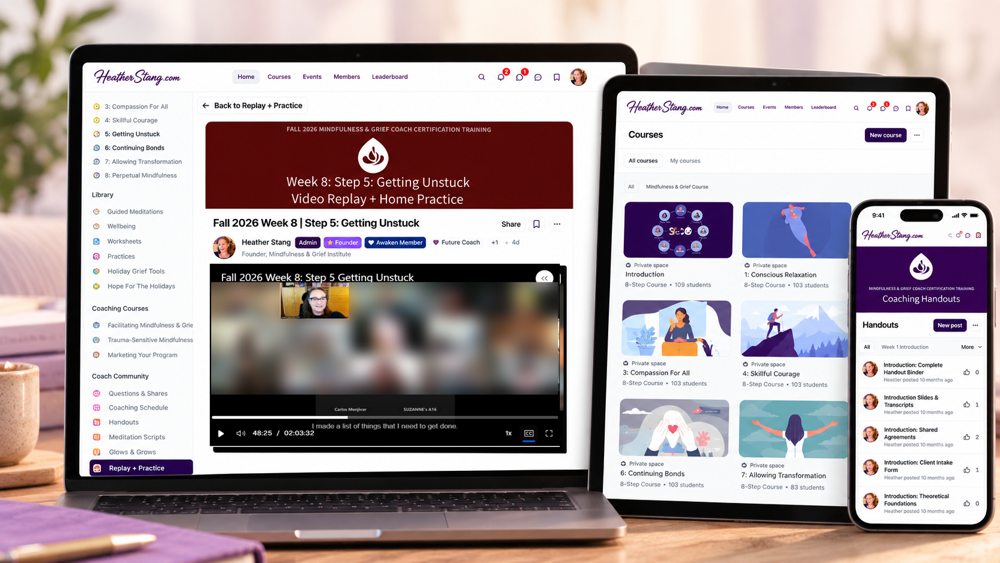
Each week combines independent learning, personal practice, peer facilitation, and two hours of live training with me and your cohort.
Prepare with videos, reading, and a quiz
You'll begin by watching approximately 30 minutes of instructional videos, taking a short quiz, and reviewing the week's training materials. These might include grief theory, facilitation guides, meditation scripts, journaling exercises, or client worksheets.
The videos and readings introduce the material before we meet, which gives us more time for discussion, questions, and hands-on practice during class.
Develop your personal practice
You'll also have your own practice throughout the week. I provide suggestions for meditation, journaling, movement, and self-care, and you're encouraged to make those practices your own.
Some weeks, you might explore a guided meditation related to the step we're studying. Other weeks, you may practice noticing your thoughts, emotions, or physical sensations as you go about your day.
We're not trying to create another list of things you must do perfectly. The idea is to experience what you're learning and discover how the practices work in your own life.
Practice with your buddy
During the eight weeks of Practice Exchanges, you'll meet with your assigned buddy and take turns facilitating the techniques you're learning.
One of you guides while the other experiences the practice. Then you switch roles.
You'll have a session guide and supporting materials to help you prepare. Over time, you'll also become more comfortable finding your own language and responding to the person you're working with.
Reflect through two Glows and two Grows
After each exchange, you'll post two Glows and two Grows. These are two things you feel went well and two things you'd like to develop.
I'll read your reflections and give you feedback each week. We'll look at the strengths you're bringing to your facilitation and how you can build on them.
You'll learn more about this process below because it's one of my favorite parts of the training.
Come together for the live class
Then we meet for our two-hour Zoom class.
We usually begin with a mindfulness practice and journaling, followed by an opportunity to reflect on what you noticed. I like to start with the person before we move into the professional work. After all, we're human beings first, and everyone in grief work brings their own experience of loss and change.
From there, we explore the theory, discuss what came up during the week's practice, and work together in breakout rooms.
Sometimes I'll demonstrate a technique. Other times, you'll practice with different members of the cohort. We return to the larger group to discuss what happened, answer questions, and explore the choices you made as facilitators.
Before we finish, I'll explain your personal and professional practice for the following week.
What if you miss a live class?
All classes are recorded, including one breakout room. You can watch the replay if you can't attend live, and I encourage everyone to watch the recorded breakout exchanges.
There's quite a bit to learn from watching how another person guides a practice, especially when you can see how they respond to something unexpected.
You can also reach me between classes. If something personal comes up during training, you're welcome to send me a direct message. Professional questions go into our community forum so everyone can benefit from the discussion.
I want you to have ways to ask questions as they arise, rather than having to remember everything until our next meeting.
The grief theory behind the eight steps
Contemporary grief theories help us understand the many ways people experience loss. They explain changes in identity, relationships, meaning, emotional responses, and the ways people adapt to life after someone dies.
But what happens when someone understands their grief and still doesn't know what to do when they're lying awake at night, caught in guilt, or feeling overwhelmed by emotions?
That's one of the questions that led me to develop the 8-Step Mindfulness & Grief System.
Beginning with my Yoga for Grief groups in 2009, I started connecting what I was learning in thanatology with what I was experiencing as a yoga therapist and mindfulness teacher.
I wanted to translate grief theory into practical skills people could learn, practice, and return to when they needed them.
The system draws on several established theories and models, including:
- J. William Worden's Tasks of Mourning, which describe processes involved in adapting to loss.
- Robert A. Neimeyer's Meaning Reconstruction, which explores how loss affects identity, meaning, and our understanding of our lives.
- Margaret Stroebe and Henk Schut's Dual Process Model, which describes how people move between attending to grief and managing everyday life.
- Continuing Bonds, including the work of Dennis Klass and colleagues, which recognizes that relationships with people who have died can remain meaningful.
- Kenneth Doka's Disenfranchised Grief, which addresses losses that may not be recognized or supported by others.
- Intuitive and instrumental grieving styles, described by Terry Martin and Kenneth Doka, which help us understand different ways people experience and express grief.
I integrated these perspectives with mindfulness, yoga therapy, self-compassion, meditation, journaling, movement, and self-inquiry.
The result is a teachable, repeatable, skill-building program for bereaved people who want something practical to do with their grief.
For example, the Dual Process Model helps explain why someone might spend part of the day missing the person who died and another part dealing with work, family, or everyday responsibilities. Both can be part of grieving.
The Mindfulness & Grief System provides practices that can support those experiences.
Someone who feels overwhelmed may find Conscious Relaxation useful. A person struggling with guilt might explore self-compassion. Someone whose identity has changed after a loss might use journaling and reflection to explore who they are now.
Understanding the theory helps you choose what to offer. Experiencing and practicing the methods helps you learn how to offer it.
A framework developed through research and practice
My master's degree in Thanatology from Hood College gave me a foundation in grief theory. My work as a Certified Yoga Therapist and mindfulness teacher brought another perspective: how grief shows up in the body, thoughts, emotions, and ordinary moments of daily life.
The Mindfulness & Grief System grew from bringing these areas together and continuing to learn from grieving people themselves.
My approach is featured in The Handbook of Grief Therapies (SAGE, 2023), edited by Edith Maria Steffen, Evgenia Milman, and Robert A. Neimeyer, in my chapter on mindfulness-based grief therapy.
In 2025, I received the Association for Death Education and Counseling (ADEC) Clinical Practice Award in recognition of my contributions to grief support.
You can read more about the system's history, theoretical foundations, and development on my Mindfulness & Grief System page.
The certification teaches you how to bring this methodology into your professional work.
A complete grief coaching framework, not a formula
The Mindfulness & Grief System includes eight steps, each designed to address different needs that can arise after a loss. They aren't stages of grief that tell people how they should feel or what they should experience next. There is, however, a thoughtful progression to how the skills are introduced and practiced.
We begin with foundational skills that help people settle their bodies, become more aware of their thoughts and emotions, and respond to themselves with compassion. From there, we introduce practices for working with difficult emotions, exploring new perspectives, maintaining connections, and adapting to life after loss.
As people develop these skills, they have more options for responding to their grief. Someone may return to Conscious Relaxation whenever they feel overwhelmed. Another person might want to explore Continuing Bonds early on, while someone else may need more time before approaching that part of their relationship.
| Step | The grieving person's needs |
|---|---|
| 1. Conscious Relaxation | Relief from physical tension, stress, and overwhelm, and ways to settle the body. |
| 2. Mindful Awareness | Greater understanding of thoughts, emotions, and reactions, with more choice in how to respond. |
| 3. Compassion for All | Kindness and understanding when facing guilt, self-criticism, isolation, or emotional pain. |
| 4. Skillful Courage | Ways to approach difficult emotions and experiences at a manageable pace, while respecting personal limits. |
| 5. Getting Unstuck | New perspectives when grief feels repetitive, overwhelming, or difficult to move through. |
| 6. Continuing Bonds | Ways to explore an ongoing relationship with someone who died, including love, anger, regret, abuse, or estrangement. |
| 7. Allowing Transformation | Room to explore changes in identity, meaning, relationships, and life after loss without pressure to find a positive outcome. |
| 8. Perpetual Mindfulness | Practical ways to continue caring for themselves and responding to grief as their needs and circumstances change. |
During certification, you'll learn both the logic behind the eight-step progression and how to adapt it to the needs of the person you're supporting.
Sometimes that means guiding a meditation or journaling practice. Other times, it means listening, asking a thoughtful question, offering a different option, or recognizing when another kind of support would be more appropriate.
The framework gives you a clear structure for teaching practical grief support skills, while the person you're working with helps determine which practices are useful and when.
Complete session guides and practical grief support tools
One of the things you'll receive is a complete collection of Facilitator Session Guides for all eight steps.
These guides help you structure one-on-one grief coaching sessions or facilitate a full eight-week Mindfulness & Grief support group.
Each guide includes the session's intention, situations in which particular practices may be appropriate, learning objectives, guided meditation choices, journaling prompts, discussion questions, and suggested home practices.
You'll also receive the corresponding meditation scripts, worksheets, and client resources.
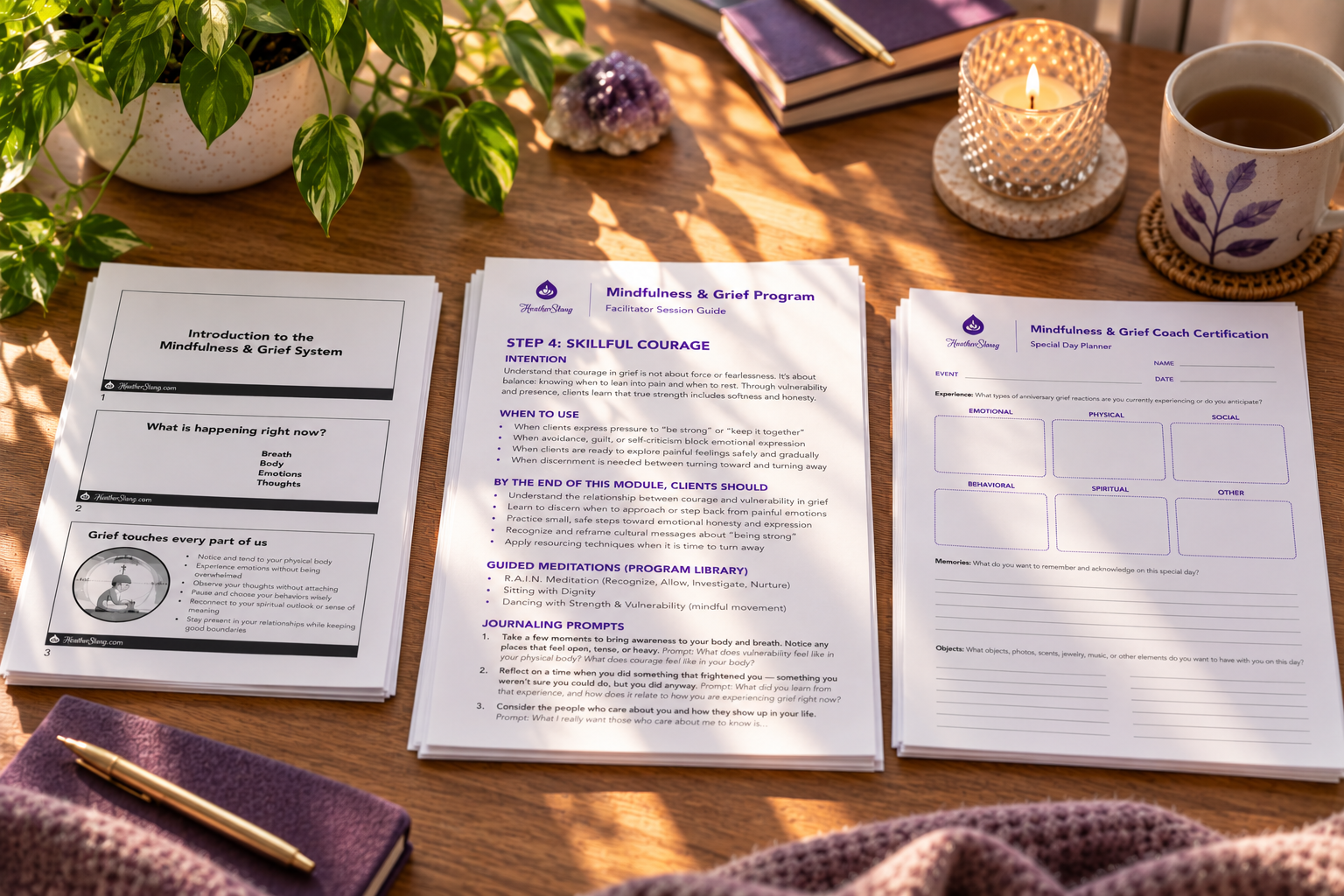
There's a complete structure to work from, beginning with explaining what you're going to explore and why, guiding the practice, inviting reflection, and helping the person consider what they might try between sessions. And there are trauma-informed choices throughout.
You might select one meditation instead of another based on what someone is experiencing. You can offer different journaling prompts, adapt the discussion, or choose a home practice that makes sense for the person or group.
I want you to have resources you can actually use, along with the understanding to decide how to use them.
If you'd like to see how this applies beyond the certification, I also have guides on how to structure a grief coaching session and how to lead a grief support group.
Continuing Bonds includes difficult relationships
Continuing Bonds is a good example of why those choices are important.
When people hear about maintaining a connection with someone who died, they often think about loving memories, comforting rituals, or carrying forward something meaningful from the relationship.
Those can be valuable parts of grief support. But not every relationship is easy.
People also grieve parents who were abusive, partners who caused harm, family members from whom they were estranged, or relationships that never became what they hoped they would be.
Someone may feel sadness and relief. They may miss the person and still feel angry about what happened. They may grieve the relationship they wished they'd had as much as the person who died.
We talk about these experiences during the Continuing Bonds training.
The intention isn't to encourage someone to maintain a positive connection with a person who harmed them or to suggest that forgiveness is necessary. Instead, we explore how a relationship has affected someone's life, what they want to carry forward, and what they may want to leave behind.
For example, the Life Imprint practice invites people to reflect on the ways someone has shaped them. That influence may include qualities they value, difficult patterns they want to change, or complicated feelings they haven't fully understood.
The Heart Center Visualization offers another approach that doesn't require someone to imagine or connect directly with the person who died.
We also explore journaling and reflection exercises that can support difficult relationships, guilt, anniversaries, and meaningful dates.
As a facilitator, you'll learn to consider what each practice asks of someone and how to offer alternatives.
A person might choose to explore the relationship, write about it, focus on their own needs, or decide that today isn't the day to do any of those things.
Their choice matters.
A secular approach that respects spiritual beliefs
The Mindfulness & Grief System is secular. You don't need to follow a particular religion, hold spiritual beliefs, or adopt a particular worldview to benefit from the practices.
Although the system draws on mindfulness and contemplative traditions, the training focuses on practical skills that can be used in religious, spiritual, and nonreligious settings.
If you're a chaplain or spiritual care provider, you can integrate the practices into your work while respecting the traditions of the people you serve. Therapists, coaches, hospice professionals, and group facilitators can use the same framework without introducing religious concepts.
Grief can bring up questions about faith, meaning, life after death, and our relationship with the person who died.
Some people find comfort in their beliefs. Others experience anger, doubt, or changes in their spiritual outlook. Some don't have spiritual beliefs at all.
There's room for those differences.
We aren't trying to influence what someone believes. We're learning to offer practices that respect their experience and give them choices.
Your Grows become Glows: Learning to coach yourself
One of my favorite parts of this training is watching students begin to trust themselves. Not because they've memorized every meditation script or know exactly what to say, but because they're learning how to recognize their strengths, notice what needs attention, and make thoughtful choices as facilitators.
That's what I mean by self-mentoring. It's a skill I bring to this certification from my training in Phoenix Rising Yoga Therapy, and it's something you'll experience throughout our 12 weeks together.
After each of your eight Practice Exchanges, you'll complete a Practice Session Self-Mentoring Observation. You'll identify two Glows, things you did well, and two Grows, things you'd like to work on. I'll read your reflections and give you personal feedback, helping you recognize what's working and explore what you might try differently next time.
Maybe you notice that you have a calming presence, but you tend to rush through a meditation because silence feels uncomfortable. Or perhaps you ask thoughtful questions, but you're so focused on what to say next that you miss an opportunity to listen.
These are wonderful things to notice. They're opportunities to learn.
Instead of telling yourself, "I'm not good at this," you can become curious. What was happening for me in that moment? What did I need? What might I try next time?
And then you get to practice again.
Something you identify as a Grow one week may become a Glow the next. I especially love when students recognize that change before I point it out.
But self-mentoring goes deeper than improving your facilitation techniques.
You're learning to embody the same mindfulness, compassion, and self-inquiry you'll eventually invite your clients to practice.
When you notice yourself feeling nervous, you can pause and ground yourself. When you make a mistake, you can respond with curiosity rather than criticism. When a client's grief reminds you of your own experience, you can recognize what's happening within you instead of automatically reacting.
You're learning to offer yourself the same kind of presence you want to offer others.
Over time, this becomes less about getting the techniques right and more about developing a trusting relationship with yourself as a practitioner. You'll become better able to recognize what you're doing well, acknowledge where you need support, and make adjustments without losing confidence.
My hope is that by the time you graduate, you won't need me to tell you every time you've done something well or what to work on next. You'll know how to coach yourself through that process.
You'll leave with more than a collection of grief support tools. You'll have practiced a way of learning, reflecting, and caring for yourself that can continue to support you throughout your professional life.
What happens during live weekly zoom coaching practices?
There's a difference between understanding a mindfulness practice and feeling comfortable guiding someone through it. That's why we spend so much of our live class time practicing together.
During our Getting Unstuck session, for example, students practiced guiding RAIN, a mindfulness technique for exploring difficult emotions. RAIN stands for Recognize, Allow, Investigate, and Nurture.
In Zoom breakout rooms, students took turns guiding a short version of the practice, paying attention to their instructions, pacing, and use of silence.
When we came back together, several students noticed they'd rushed through Investigate, the part where we invite someone to explore how an emotion feels in their body. Others realized they were giving too many instructions because they weren't sure whether they'd said enough.
We talked about how uncomfortable silence can feel when you're facilitating. You may wonder whether the person is following along or whether you should say something else. But often, that silence is exactly what someone needs to explore their experience.
We also looked at what was happening for the facilitators. What made them want to fill the silence? What might they try differently next time?
This is where learning to facilitate and learning to self-mentor come together.
You're practicing more than the words in a meditation script. You're learning to notice your own reactions, become more comfortable with uncertainty, and give the person you're supporting room to discover what they need.
Personal practice is part of professional development
You can't always know how a mindfulness practice will feel to someone else until you've experienced it yourself. That's why personal practice is an important part of this certification. You'll explore the same meditation, journaling, movement, and self-compassion techniques you're learning to offer your clients.
Some practices may feel natural and helpful. Others might bring up resistance, frustration, or emotions you weren't expecting. You may even discover that a technique you love isn't right for you on a particular day. All of that helps you understand why offering choices matters and how to recognize when a practice needs to be adapted.
There's another reason we make time for personal practice. Most of us come to grief work with experiences of loss of our own, and supporting grieving people can sometimes bring those experiences to the surface. During training, you'll practice noticing your reactions, recognizing what you need, and developing ways to care for yourself when the work feels emotionally demanding.
We'll also explore the difference between being present with someone's pain and feeling responsible for making it better. You can care deeply about the people you support while maintaining boundaries and recognizing what belongs to you and what doesn't.
The goal isn't to become unaffected by other people's grief. It's to develop the self-awareness and personal practices that help you do this work without losing sight of your own well-being. These are skills you can continue drawing on throughout your professional life.
Trauma-informed grief coaching facilitation and ethical practice
When you're guiding someone through a mindfulness practice, you can't always predict what may come up. Paying attention to the body, exploring difficult emotions, or reflecting on a relationship can sometimes bring up memories or experiences the person wasn't expecting.
That's why we introduce facilitation skills and trauma-sensitive mindfulness early in the certification. You'll learn how to offer choices, adapt practices, recognize when someone may need a different approach, and respect their decision not to participate. We also cover informed consent, confidentiality, cultural considerations, professional boundaries, and when to refer someone for additional support.
During one of our classes, a student asked what to do if an expressive exercise brings up earlier trauma. It's a useful question because these situations can happen even when you've thoughtfully prepared a session. We discussed how to respond with compassion, stay within your professional scope, and recognize when someone may benefit from working with a qualified mental health professional.
You won't always know exactly what someone needs, and you can't anticipate every response. What you can do is develop the skills to recognize what's happening, listen carefully, and make thoughtful decisions rather than feeling you have to fix or resolve whatever comes up.
The Certified Mindfulness & Grief Coach credential demonstrates that you've completed professional training in my methodology. It doesn't replace clinical licensure or authorize mental health diagnosis or treatment. The practices can complement your existing professional skills, provided you use them within your qualifications and scope of practice.
If you'd like to understand these distinctions more clearly, I've written about grief coaching versus therapy.
After you graduate: Ongoing support and opportunities
Earning your Certified Mindfulness & Grief Coach credential is an important milestone, but your connection to the training doesn't end there. Once you've completed the coursework, eight Practice Exchanges, and required assessments, including the certification exam, you'll have resources and opportunities to support you as you put what you've learned into practice.
You'll retain access to your training materials and future updates, including the facilitator guides, meditation scripts, worksheets, and other resources. You can revisit them whenever you need a refresher or want to bring a new element of the Mindfulness & Grief System into your work.
You'll also have access to my ethical marketing workshops, where we explore how to describe your services, communicate the value of your work, and connect with people who may benefit from your support. I'm also developing a directory on my website where eligible certified graduates will have the opportunity to be listed. The directory is coming soon.
If you'd like to continue learning and connecting with other graduates, you can join the optional Certified Coaches Circle. It offers monthly masterminds, special events, and opportunities to share experiences and learn from colleagues doing similar work.
Some graduates bring the system into their existing counseling, hospice, coaching, or teaching practice. Others develop individual grief coaching services or begin facilitating grief support groups. Whatever direction you take, you'll have a complete methodology, practical resources, and opportunities for ongoing support as your work evolves.
How does this training compare with other grief certifications?
Grief coach certification programs vary widely in their depth, approach, and opportunities for hands-on learning. Some are short, self-paced online courses with little personal support or mentoring. Others follow a more rigid format, are rooted in a particular religious tradition, or place less emphasis on established grief research. There are also excellent programs that offer comprehensive training and meaningful professional development.
The right choice depends on your background, values, how you like to learn, and the kind of grief support you want to offer.
My Mindfulness & Grief Coach Certification combines established grief theory, mindfulness practices, live experiential training, and personal mentoring. You'll learn a complete 8-Step Mindfulness & Grief System while developing the skills to adapt it to the people you're supporting.
The approach is secular, trauma-sensitive, and choice-based. You'll have a clear framework to guide your work, along with the flexibility to respond to different needs, beliefs, and circumstances rather than expecting everyone to follow the same path through grief.
When comparing programs, I encourage you to ask how much opportunity you'll have to practice, whether you'll receive individual feedback, what materials you'll have after graduation, and how the training addresses ethics and professional boundaries.
For more guidance, read How to Choose a Grief Coach Training Program.
What will you be prepared to do?
By the end of our 12 weeks together, you'll have practiced guiding the Mindfulness & Grief System, received personal feedback, and developed a clearer sense of how to use it in your own professional work.
You can bring the system into individual grief coaching, facilitate a structured eight-week grief support group, or adapt its practices for workshops and retreats. Whether you're incorporating grief support into an existing practice or developing new services, you'll have facilitator guides, meditation scripts, journaling prompts, and worksheets to help you plan and lead sessions.
You'll also be better prepared to choose practices that fit the people you're supporting, recognize when an approach needs to change, and understand when a referral may be appropriate. Through self-mentoring, you'll have practiced evaluating your own work so you can continue learning and adapting long after graduation.
And you'll have had the opportunity to build relationships with other professionals who care about this work. One of my favorite parts of teaching in a cohort is watching students learn from each other's experiences, encourage one another, and form connections that sometimes continue well beyond the training.
After more than two decades in grief work, I know how valuable it is to have colleagues who understand what you do. My hope is that you leave with practical skills and resources, greater trust in your ability to use them, and a community you can continue learning from.
Is this the right grief coach training for you?
If you already have experience supporting others and want to bring a structured, mindfulness-based approach to grief into your work, this certification may be a good fit. You don't need to start from scratch. You'll build on the professional skills and life experience you already have while learning a complete methodology for helping people navigate grief.
This is an active, experiential training, not a course where you simply watch videos and take an exam. You'll need to make time each week for independent learning, personal practice, partner exchanges, and our two-hour live class. You'll have opportunities to try new skills, ask questions, receive feedback, and discover what works for you as a facilitator.
My hope is that you leave with more than a certificate. I want you to understand what you're offering and why, feel comfortable adapting the practices to the person in front of you, and trust yourself to recognize both your strengths and the areas where you want to keep growing.
If that sounds like the kind of learning experience you're looking for, explore the 12-week Mindfulness & Grief Coach Certification to review the curriculum, see what's included, and find details about the next cohort.
You can also book a free 20-minute call with me through the certification page. We can talk about your background, what you're hoping to do with the training, and whether it's a good fit. I'd be happy to help you decide.