Mindfulness & Grief Coach Training Schedule
This training follows a clear path, from foundations to the full 8-step Mindfulness & Grief System.

Learn an evidence-informed system for supporting people through grief with meditation and journaling, while caring for your own wellbeing, too.
September 4 - November 20, 2026
Fridays 12:00 PM - 2:00 PM ET · Tuition: $1,495
Curious if the certification is right for you?
Schedule a free 20-minute call with Heather to talk it through.
Taught by Heather Stang, MA, C-IAYT, recipient of the
2025 Association for Death Education & Counseling Clinical Practice Award for Innovation in Grief Support.

You may already know how to listen, stay present, and create a safe space. But when grief becomes overwhelming, good intentions and theory do not always tell you what to do next.
This certification gives you practical, evidence-informed practices you can use in real sessions, along with a framework that helps you know when and how to use them.
Curious if the certification is right for you?
Schedule a free 20-minute call with Heather to talk it through.

Grief Counselor
Certified Mindfulness & Grief Coach - Fall 2025
Supporting grief doesn’t mean being everything to everyone.
You’ll learn how to provide compassionate, mindfulness-based grief coaching within a clear, ethical scope of practice. You’ll know when coaching is appropriate, when someone needs additional support, and how to refer out with confidence.
This professional, non-clinical certification is designed to complement your existing work, not replace psychotherapy, counseling, or medical care.
You’ll leave with a clearer sense of what is yours to hold, what isn’t, and how to support grieving people safely and confidently.
For a full explanation, read Grief Coaching vs. Therapy for Professionals: Scope, Training, and Key Differences.
Curious if the certification is right for you?
Schedule a free 20-minute call with Heather to talk it through.
You will learn directly from Heather Stang, the recipient of the 2025 Association for Death Education and Counseling Clinical Practice Award for Innovation in Grief Support. She is recognized for her contributions to trauma-informed mindfulness and grief care. She is also the author of three books: Living With Grief, From Grief To Peace, and Navigating Loss.
The 8-step Mindfulness & Grief System is featured in The Handbook of Grief Therapies, a respected resource for clinicians and educators. Heather’s professional grief training shows you how to apply these evidence-informed practices with real people in real settings so you can confidently support many types of loss.
Heather’s work is grounded in the field of grief (thanatology) and offers a practical approach for professionals seeking deeper understanding of grief and compassionate client care.
Unlike a self-paced course, this is a live, supported training where you are not learning alone. You will practice the framework in a small cohort, receive two hours of live guidance each week, and have direct access to Heather through community messaging as you build confidence with client-ready tools.
Curious if the certification is right for you?
Schedule a free 20-minute call with Heather to talk it through.
You may have taken courses that left you with notes, ideas, and good intentions, but no clear way to put them into practice.
This certification is different. You’ll experience the work yourself, learn a step-by-step framework, practice with live support, and leave with tools you can use in real sessions.
You won’t leave wondering how to turn what you learned into meaningful client care. You’ll leave with a clear system, practical experience, and ongoing support as you begin using it.
Certified Mindfulness & Grief Coach - Spring 2026
Curious if the certification is right for you?
Schedule a free 20-minute call with Heather to talk it through.
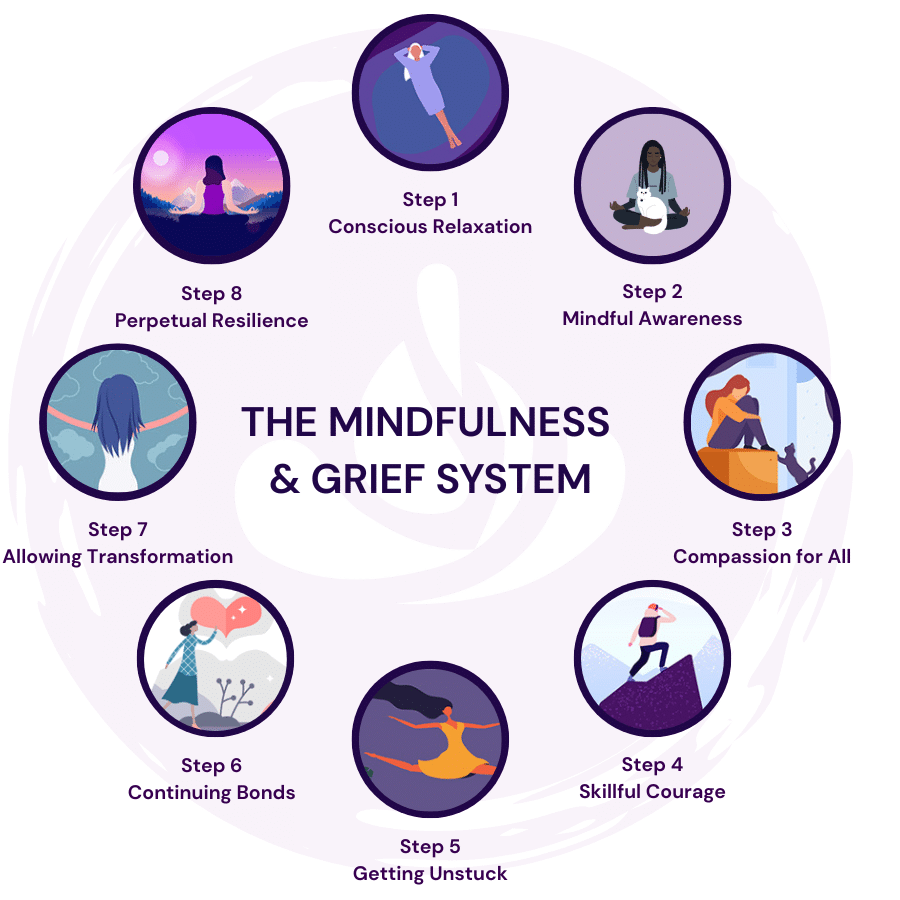
This training is built on a structured, research-informed framework grounded in established grief theory and trauma-sensitive mindfulness.
You’ll experience the full 8-step system yourself while learning how to guide it ethically, safely, and confidently with others.
Each step includes guided meditation, journaling prompts, reflection practices, and facilitation guidance you can adapt for both group programs and individual sessions. You do not need to be an experienced meditation teacher to begin. You’ll receive scripts, audios, and practical support so you can lead the practices with care.
Over time, the system becomes more than something you understand. It becomes something you have practiced, embodied, and can trust when supporting grieving people.
alexandria cirko
Chaplain, VP Mission & Ministry
Mindfulness & Grief Coach - Spring 2026
Curious if the certification is right for you?
Schedule a free 20-minute call with Heather to talk it through.
You’ll receive a complete library of tools to help you guide clients with confidence, structure, and compassion.
24 Meditation Scripts
Ready-to-use scripts so you never have to improvise what to say.
33 Guided Meditations
Audio practices you can use for your own integration or share directly with clients.
8 Facilitation Guides
Complete session plans for leading full groups and private coaching clients.
12 On-Demand Courses
Weekly lessons that build your knowledge and confidence.
12 Live Q&A + Training Events
Real-time support, case discussion, and guided skill practice.
Includes Lifetime Access and Updates to the Entire Training Library
This training follows a clear path, from foundations to the full 8-step Mindfulness & Grief System.
Build a strong foundation in the Mindfulness & Grief System so you can begin supporting grieving clients with greater clarity, confidence, and care.
Create sessions that feel grounded, supportive, and complete, so clients feel safely held from beginning to end.
Explore trauma-sensitive principles such as pacing, choice, and safety, giving you the skills to adapt practices for each client without overwhelm.
Guide relaxation meditation practices that help clients settle their nervous systems, feel less overwhelmed, and find moments of relief in the midst of loss.
Learn how to guide mindfulness meditations that help clients meet each moment with more presence and less fear, so they can stay connected to themselves without getting swept away.
Introduce self-compassion meditation practices that soften self-blame, reduce isolation, and help clients meet their pain with greater kindness.
Support clients in approaching difficult emotions as important messengers, so they can listen to what their loss is asking for without becoming overwhelmed by it.
Use expressive arts, journaling, movement, and metaphor to help clients loosen loops such as rumination, avoidance, and emotional paralysis.
Empower clients to stay connected to the person who died in ways that feel meaningful, comforting, and restorative, even if the relationship was less than perfect.
Create space for clients to understand how loss is reshaping them, and to notice what is emerging alongside the pain.
Bring the full Mindfulness & Grief System together so clients can build resilience, make meaning, and begin living more fully after loss.
Integrate the full framework into your own facilitation style, learn about ongoing professional support, and apply ethical marketing for sharing your work with integrity.
Curious if the certification is right for you?
Schedule a free 20-minute call with Heather to talk it through.
Julia Rajtar, M.A.P.S., B.C.C.
Chaplain, Bakkan-Young Funeral & Cremation Services
Certified Mindfulness & Grief Coach - Fall 2025
I developed the Mindfulness & Grief System after leading groups and returning years later to speak with participants about what had truly stayed with them.
I wanted to understand what supported people beyond the initial shock of loss, what helped them continue living alongside grief, and what made them feel less alone over time.
This training is designed to give you more than knowledge. It gives you a structure you can trust, practices you can embody, and tools you can use with confidence.
My hope is that you leave feeling more grounded in yourself, clear in your role, and better prepared to support others with steadiness and care.
Heather’s work has been recognized by leading voices in mindfulness, loss, and bereavement care.
“When we are more firmly grounded in our bodies, as Heather Stang demonstrates, we are better able literally and metaphorically to find a new footing in the world, and to restore a life of meaning and coherence.”
ROBERT A. NEIMEYER, Ph.D.
Director, Portland Institute for Loss and Transition
“Heather Stang offers those who are grieving a wise and practical guide. The stories, teachings and meditations in this book will help you find your own inner strength and awakening heart in the midst of great loss.”
TARA BRACH, Ph.D.
Author of Radical Acceptance and True Refuge
Curious if the certification is right for you?
Schedule a free 20-minute call with Heather to talk it through.
D.R.
Chaplain, Bakkan-Young Funeral & Cremation Services
Mindfulness & Grief Coach - Spring 2026
If you’re considering joining, these are the questions most professionals ask before enrolling.
This is a 12-week live training with a clear structure. Plan for around 4 hours per week including live instruction, practice, and integration.
Live attendance is encouraged but not required. Replays are available within 24 hours, so you will not fall behind if life happens.
You do not need to be a licensed therapist to enroll, but you must already work with people in a professional or volunteer capacity. This training does not grant a therapy license.
You agree to practice within your existing scope and apply the 8-step framework ethically in your setting.
This is a professional training designed to prepare you to responsibly guide others through loss. If you are currently grieving and feel called to support peers, your readiness matters.
We encourage you to schedule a call with Heather to talk through your experience and goals. Together, you can determine whether this is the right next step.
Yes, as long as you participate in the program. You will move through the full 8-step process yourself before guiding others, building embodied understanding rather than just learning theory.
You will practice leading exercises during the program and receive feedback from your practice partner or group, while using practical facilitation guides, scripts, and worksheets that support you every step of the way.
You will learn how to confidently facilitate a full 8-week Mindfulness & Grief group and apply the same 8-step framework in individual sessions.
The training prepares you for both settings, so you can adapt the structure to your professional role and the needs of the people you serve.
If you are enrolling with colleagues, view available discounts on the Group Pricing page.
If you would like to pay over time, you may select the PayPal checkout option and apply for a payment plan directly through PayPal. Approval and installment terms are determined by PayPal at checkout.
Curious if the certification is right for you?
Schedule a free 20-minute call with Heather to talk it through.
A grief coach is a non-clinical professional who provides support, structure, and mindfulness-based tools to help people adapt to life after loss. Unlike a therapist, a coach focuses on present-moment coping and rebuilding a sense of purpose rather than diagnosing or treating mental health conditions.
A practitioner in this role helps guide clients through grief with structure, compassion, and practical tools, while staying within a non-clinical scope of practice.
For a deeper explanation, read What Is a Grief Coach?.
This training is for therapists, mental health professionals, social workers, chaplains, loss specialists, death doulas, hospice professionals and volunteers, funeral directors, yoga teachers, yoga therapists, meditation teachers, life coaches, somatic practitioners, spiritual directors, and other professionals who support grieving people.
It can also support professionals who want to deepen their work with grief and loss, whether they are in private practice, hospice care, spiritual care, or community-based services.
A Christian grief coach, spiritual care provider, chaplain, or faith-informed helping professional can also use this framework within their own ethical scope and tradition.
No. While therapy treats clinical diagnoses, this work focuses on present-moment coping, mindfulness, and meaning-making. This training includes referral protocols to help practitioners work safely within a non-clinical scope.
For a full explanation, read Grief Coaching vs. Therapy for Professionals: Scope, Training, and Key Differences.
The Mindfulness & Grief System is Heather Stang’s 8-step, research-informed framework for care after loss. It combines established grief theory with trauma-informed mindfulness to help clients move from overwhelm to resilience.
Learn more about The Mindfulness & Grief System.
This training is designed for professionals such as therapists, chaplains, death doulas, hospice workers, loss professionals, coaches, and others who want a structured, evidence-based system for supporting bereaved individuals and groups.
For more detail, read How to Become a Grief Coach.
No. You do not need to be a licensed therapist to enroll. You do need experience working with people and a commitment to practice within your professional scope.
You may also find How to Become a Grief Coach Without a Degree helpful.
No. This training does not grant a therapy license or board certification. You agree to practice within your professional scope.
For more on the difference between coaching and clinical care, read Grief Coaching vs. Therapy for Professionals: Scope, Training, and Key Differences.
This is a professional certification, not a university degree, therapy license, board certification, or ICF-accredited life coach training.
It is designed to help professionals and helping practitioners use Heather Stang’s Mindfulness & Grief System within their existing scope of practice.
This program does not currently offer hours of continuing education or continuing coach education through the International Coaching Federation.
The certification requires completion of the course videos, weekly check-ins, ethical practice agreements, and the final assessment.
For help comparing programs, read How to Choose a Grief Coach Training Program.
This is not a personal grief recovery program or a substitute for therapy.
It is a mindfulness-based certification course that teaches a trauma-informed, non-pathologizing approach to supporting people after loss.
Yes. We teach skills that honor grief as a human experience. No stages. No forced timelines.
You can learn more about the skills involved in this work in Essential Skills for Grief Coaching.
Yes. You’ll receive a structured framework, scripts, facilitation guides, ethical guidance, and practical tools that can support your private practice, group programs, or existing professional services.
Yes. This is a certified grief coach program for helping professionals who want to use the Mindfulness & Grief System in ethical, scope-aware practice.
It is both a grief coaching program and a professional certification. You will learn the Mindfulness & Grief System, practice the 8-step coaching model, and complete the requirements to get certified within your professional scope.
This training program is designed to help you grow personally and professionally. You’ll build skills, deepen your confidence, and learn how to support individuals with grief-related challenges in a clear and compassionate way.
Yes. This is an online program with live weekly sessions and recorded replays. It is not an in-person training, and it is not a learn-at-your-own-pace course because live support and cohort practice are part of the experience.
Plan for about 4 hours each week. This includes the 120-minute live session with Heather, which is recorded if you miss it, about 30 minutes of training videos, and time for practice and integration.
You can work with your existing clients or request to be paired with a practice buddy from your cohort. If you practice with someone from the cohort, it will be an exchange, which adds about an hour to your weekly practice time because you will both take turns leading.
Live attendance is encouraged, but not required. Replays are posted within 24 hours, so you will not fall behind.
After you enroll, you will receive access to the live session links, course materials, audios, scripts, prompts, and replays in one place.
Each week includes guided meditation audio, client-ready scripts, a short in-the-moment practice, a journaling prompt, the session replay, and time with your cohort.
For more on grief journaling as a practice, read Grief Journaling: How to Start.
Aim for about 10 to 15 minutes of personal practice most days. The goal is not only to learn the material, but to embody it in your own life and work.
To become certified, you will need to watch all course videos, attend the weekly live session or watch the replay, complete a brief weekly self-mentoring check-in in the community chat, and pass the 50-question multiple choice exam.
In your weekly check-in, you will briefly reflect on your learning and stay engaged. You will also agree to practice ethically, protect client privacy, and stay within your professional scope.
No. Scholarships are not available at this time. You can pay over time through PayPal or enroll with a friend or colleague for a group discount.
Yes. We offer discounted rates for teams who enroll together in our grief certification training. See the Group Pricing page for current options and details.
Yes. To pay over time, choose the Pay Over Time option, which will take you to PayPal. Select Pay Later at checkout. PayPal handles approval and installment options directly. If Pay Later is not available on your account, you will need to use another payment method.
Yes. You may use the scripts, worksheets, and prompts with attribution, as long as you stay within your professional scope.
For related guidance, read How to Lead a Grief Support Group.
No. CE credits are not offered.
This program does not currently offer hours of continuing education or continuing coach education through the International Coaching Federation.
Yes. All videos are closed captioned, replays are available, and materials are provided in readable formats. If you need support, please ask and we will do our best to accommodate you.
You will need reliable internet access, Zoom, and headphones or speakers. Enrollment details and access instructions will be provided after registration.
Maybe. This is a professional training with an assessment, not a personal healing after loss program. You will be invited to reflect on your own experience with the work.
If you can focus during class and practice consistently, you may do well. If you need dedicated support right now, it may be better to begin with personal care after loss or a private session first.
After you enroll, you will receive access instructions, add the session dates to your calendar, and find your Week 1 materials waiting for you.
Join the next live Webinar and Q&A session or book a free discovery call with Heather to talk through whether this training is the right fit for you.
Curious if the certification is right for you?
Schedule a free 20-minute call with Heather to talk it through.