When I was about 14 years old I started writing in a journal. I was a grieving child. My mom's brother, Uncle Doug, died by suicide when I was just 7, and as I grew older some pretty big questions emerged. My family didn't talk about it much, as you can imagine, so my journal became my confidant. It was a way for me to wrap my head around what had happened, express what I was feeling, and discern who I was becoming in the wake of it all.
Decades later I was asked by my publisher to write From Grief to Peace, a guided journal designed to do exactly what the title says. Most people pick up a journal to cope with the pain of loss. But it can also help you honor your love, record memories, and get to know yourself better through the process.
Writing To Process Your Grief
In the book Lessons of Loss: A Guide to Coping, Dr. Robert Neimeyer explains that losses, especially traumatic ones, can be difficult to discuss or even disclose to another person. Carrying painful memories without a way to express them can take a toll.
There is no shortage of research showing that writing can be a useful grief tool for a bereaved person. A key principle in grief therapy is reconstructing your personal narrative, and journaling gives you a place for expression without fear of being judged.
Your journal can help you speak your truth without judgment, untangle confusing thoughts, honor your loved one, and explore your continuing narrative in your life after loss.
If it feels right to you, your grief journal can continue your conversation with your loved one after their death. After all, the relationship you have never goes away. The nature of it simply changes. You can ask them questions and imagine their answer. Tell them about what is going wrong, and what is going right.
Journaling Can Feel Different When You're Not Doing It Alone
Journaling gives you a private place to put words around what is happening. But sometimes you may want more than a blank page. You may want a little guidance, a practice to help you settle in, or other people who understand why grief can still feel hard months or years after a loss.
Inside the Mindfulness & Grief School, we use journaling alongside guided meditation, mindfulness practices, and live grief support. You can join the live classes when you want connection, or use the meditation library, courses, and other resources on your own.
The point isn't to journal your way out of grief. It is to have practices you can return to when you need them, and a place where you don't have to explain why your grief still matters.
Explore the Mindfulness & Grief School →
Styles of Journaling
Free Writing vs. Guided Grief Journal Prompts
Most people associate journaling with freestyle or stream-of-consciousness writing. This is where you transcribe whatever crosses your mind. No editing. No spellcheck. You don't even need to make sense. You just write.
This gives you a lot of space to write whatever you feel and can be a great way to record your day-to-day experience. The downside is that a blank page can seem intimidating, and some people find that writing without direction can lead to a cycle of negative rumination.
One grief journaling study found that directed writing with writing prompts that focused on meaning reconstruction was more helpful than freeform grief journaling that focused on emotion and disclosure. Grieving participants who received the guided grief prompts experienced long-term improvement in prolonged grief disorder, depressive, and post-traumatic stress symptoms. They also saw improvement in physical health.
Powerful Grief Journal Prompts to Get You Started
If you feel paralyzed when writing in a grief journal, or you feel like what you are writing is not serving your needs, writing prompts and guided journals can also help you get unstuck.
You can write prompts yourself, search for them online, or find a collection in a guided journal for grief like my own From Grief to Peace.
If you're ready to start journaling but need some guidance on what to write, check out 15 Powerful Grief Journal Prompts to Help You Heal. Here are a few other favorites:
- I remember when you and I....
- This is what I have to say to you....
- The first time I did _____ without you I....
- My happiest memory of you is...
- The greatest lesson I have learned is...
A hybrid approach is also a good choice, combining grief journaling prompts with a traditional journal that gives you the space you need to process the nuanced experience of loss.
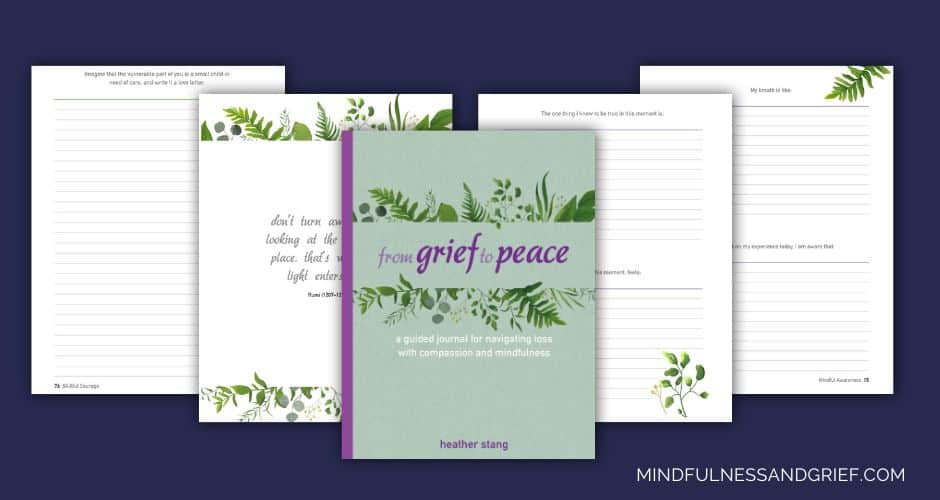
The Best Grief Journal for You
Paper Journals
Paper options are plenty. Choose a small notebook or journal that will fit in your purse if you plan to write on the go or tote it back and forth to a counseling or group session. A spiral-bound notebook is a discreet option if you plan on writing at work or want to avoid prying eyes at home. A more formal journal or diary carefully selected in a bookstore or specialty shop can remind us of the significance of our words. There isn't a right or wrong choice.
Consider what you will write with. Any nearby pen or pencil will work, of course, but some writers find that a special pen with the "right feel" helps them get going more quickly. Different-colored writing instruments can help you designate mood or switch back and forth between questions and answers when engaged in dialogue or inquiry.
Don't forget that there are no rules. Go beyond prose and add illustrations, poetry, and even collages and photos if it helps you tell your story and explore your true feelings. You may reserve some of your journal pages to paste photos of special memories, sketch a personification of your mood, or create a memory-book-style collage.
My first journal was 3-hole-punched, lined notebook paper that I stuck in a folder with brads to hold it together. While it may vary depending on your preferences and lifestyle, a good grief journal will be easy for you to access when you want to record your thoughts. It will also be secure enough for you to confidentially explore a wide range of your feelings.
Remember my notebook paper journal? I wish I could share it with you, but my father found it, yelled at me, and promptly threw it out. It pains me that I cannot reread what adolescent Heather had to say about her uncle's death, and I imagine there was a lot of commentary on family dynamics as well.
I don't say this to scare you off from journaling. It is exactly these types of truths that can be useful to move from mind to paper. If you are concerned about prying eyes, a password-protected digital journal can come in handy.
Digital Journals
If you prefer journaling on your computer or smartphone, you, too, have plenty of options. Perhaps the simplest solution is a document or notes app that you can password protect for privacy.
You don't need a special grief journaling app. If you already have a secure place to write on your phone, tablet, or computer, that may be all you need.
Digital journaling can also be useful if typing is easier for you than handwriting, you want to write when you're away from home, or you like being able to search older entries and revisit what you wrote.
As with a paper journal, privacy matters. Choose something that lets you write what you actually think and feel without worrying about someone else stumbling across it.
Tips for Journaling Through Grief
Grief journaling is not about writing perfectly. It is about expression. Here are some of the tips for writing in your grief journal I explore in the introduction of From Grief to Peace:
- There are no right or wrong answers.
- Mindfully engage with your whole being.
- Approach familiar subjects as if it were the first time.
- Walk up to the edge, but don't fall over.
- Seek out physical and emotional support as needed.
- Go through the journal in order. Or don't.
That last one applies if you choose a guided grief journal. You are allowed to skip a prompt that doesn't interest you, jump ahead, or come back to something later.
The journal is there to serve you, not the other way around.
Going Public
Personal blogs, social media, newsletters, and other online spaces give you the option to share your writing. Your words may inspire others, honor your loved one, or connect you with people who are also grieving.
If you do take your grief journal public, however, consider the pros and cons.
Will your inner critic censor your thoughts in a way that suppresses your authenticity? Many of us struggle with this notion in our private grief journals. Inviting others in may change what you are willing to write, or it may help.
You may want to try a hybrid solution. First, write in a private space, and then choose what to share with the public. This approach allows you to write with raw honesty and then decide what, if anything, you want to share with the world at large.
Whatever medium you choose, let the practice be yours. Write regularly if that helps. Write when you need to if that works better. Use prompts when you want direction and blank pages when you don't.
Keep Your Grief Practice Going
A journal gives you somewhere to put what is happening today. What you need tomorrow may be different.
Sometimes you may want to write. Sometimes a guided meditation may be more useful. And sometimes what you really need is to be with other grieving people who get it.
The Mindfulness & Grief School gives you all three, with live grief support, guided meditations and journaling, courses, and resources you can use on your own. You don't have to decide on one "right" way to work with your grief.
Try what interests you. Keep what helps. Leave the rest.