

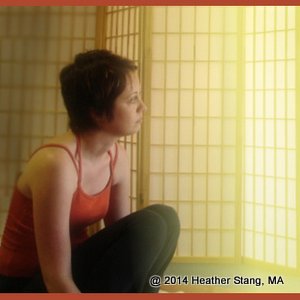
When your heart aches the perspective on life narrows; The panorama of a once full life zooms in to the detail of suffering, and the body closes in on itself in an attempt to protect the heart from further pain. In yoga we call this a body coping strategy. While your body thinks it is doing you a favor by protecting you, in reality it is most likely causing more aches and pains by holding onto tension.
Can you imagine what it might be like to give your body a time out from holding all that stress? You can, and it only takes a few minutes to learn from your body. In this exercise I invite you to silence any internal judgments or prejudices about your body. Imagine you could approach yourself right now with loving compassion (If loving compassion feels too edgy right now, at least imagine seeing yourself through neutral eyes). Take as much or little time as you need for this practice.
Preparation: Find a quiet place where you wont be disturbed. You may sit or lay down, and you will want your journal or a piece of paper handy. You will also need three different colored crayons, pens or colored pencils.
Step 1: Breath Awareness
Don’t breathe in any special way right now. Just get to know your natural rhythm in this moment. What do you notice about your breath? Is it deep or shallow? Easy or tight? Where do you feel your breath the most in your body?
Take a few moments to expand your breath – lengthening your inhales and exhales. What do you notice?
Return to an easy, resting breath.
Step 2: Body Awareness
Begin at the crown of your head, and begin to scan down to your feet. Take your time, and imagine this is the first time you noticed each body part. Be curious about your body – bones, muscles, joints, organs. Explore the whole range of your body sensations: pleasurable, unpleasurable and neutral.
Repeat as many times as you wish to get to know your body better.
Step 3: Mapping the Body
Draw an outline of your body on your journal or on a piece of paper. Don’t worry – it doesn’t need to be rendered perfectly! (You may also find body outlines for download on Google images).
With one color crayon/pen/pencil, shade in the areas of your body that felt tense, tight, stressed or otherwise unpleasurable.
With another color, shade in areas that feel pleasant, open, at ease.
With the third color, shad in areas that felt neutral.
What do you notice about your body? Take 5 to 10 minutes to write in your journal any observations, again without judging what comes out.
Home Practice
This week your home practice has three components.
- Find a way to be kind or nurture the parts that felt unpleasant.
- Celebrate the parts of your body that felt pleasurable.
- Get curious about the parts that felt neutral. You may learn something new about them, or simply discover that they are indeed neutral!
Extra Credit
Of course there are no real grades, but you may wish to go deeper by journaling each day this week about your relationship to your body.
You may also sign up to receive a free download mp3 of me leading a body scan – just fill out the form on the right side of the page.
Contact me – I would love to hear about your experience and welcome your questions!
Jai, Heather