

Grief can make us live from the neck up. We think about what happened. We replay what we should have done. We search for meaning, for answers, for some way to make sense of what feels unbearable.
But grief is not only something we think about. It is something we carry in the body. In an earlier article on bodywork for grief, I wrote about how grief can live in the nervous system, muscles, breath, and senses, and why body-based support can be such an important part of healing after loss.
That is one reason I return again and again to Phoenix Rising Yoga Therapy for grief.
Phoenix Rising gave me a framework for something I had already begun to discover through my own healing: sometimes grief does not need more analysis first. Sometimes it needs a safe, compassionate way to be felt in the body.
How I found Phoenix Rising Yoga Therapy
My path to Phoenix Rising began through my own grief.
At my first Kripalu retreat, just after 9/11, I had a profound somatic release in tadasana. I cried for my uncle who died by suicide, for my struggle with bulimia, for old untended losses, and for the collective grief in the room. That experience brought me back to my body’s wisdom. I realized that I had ignored my body, but my body had not ignored me. My body knew things my consciousness did not, and that I had more power to nurture myself than I had ever realized.
That weekend rekindled my relationship with myself and helped me see that healthy coping skills are learnable. But my next visit to Kripalu took me even deeper.
I signed up for a Phoenix Rising Yoga Therapy session almost by accident. What followed felt more like kismet.
My first Phoenix Rising Yoga Therapy session
What struck me immediately was that this was different from a yoga class, and different from talk therapy.
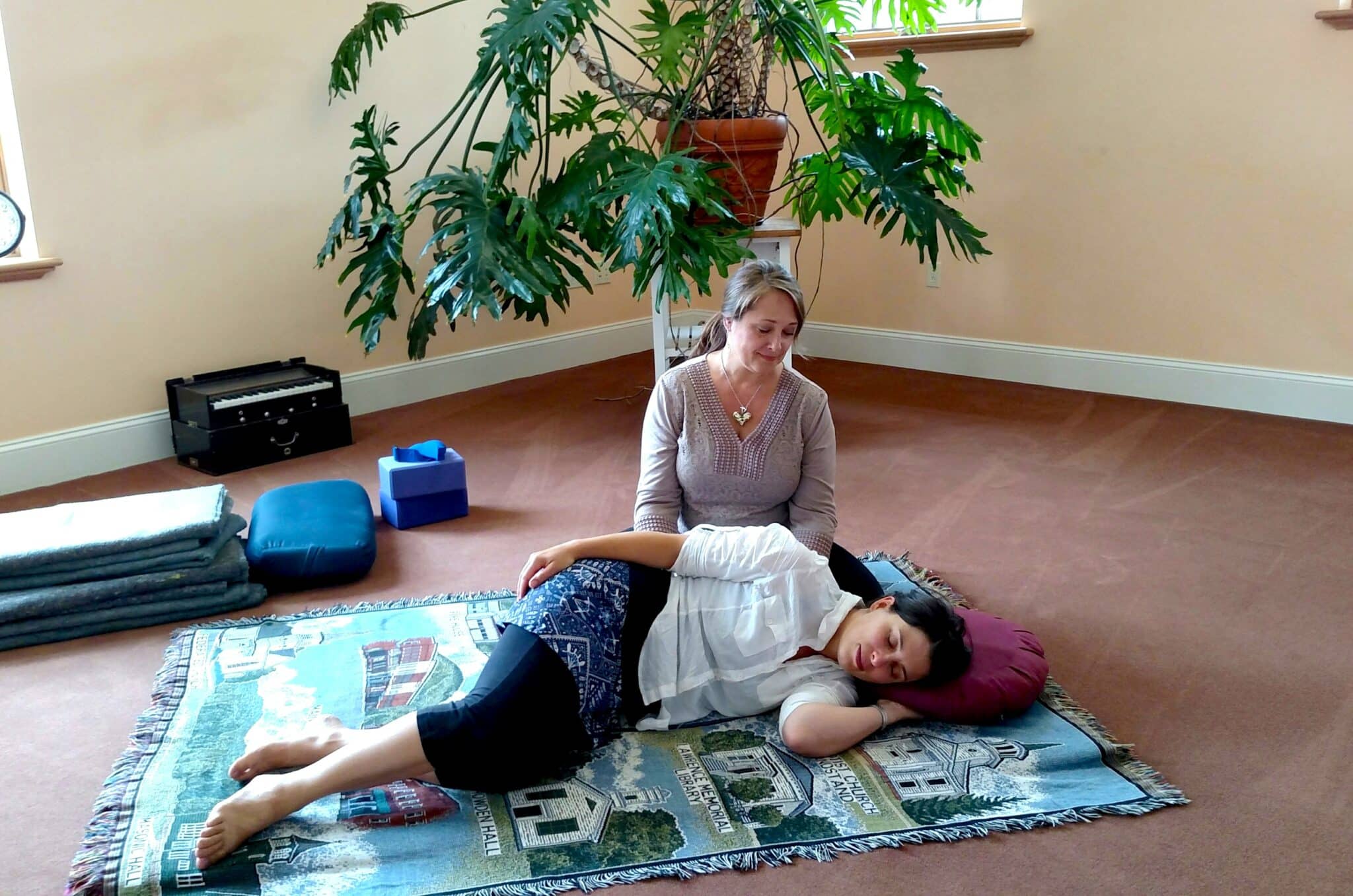
I was not being asked to perform a posture or follow a room full of students. And I was not being left alone with my thoughts, trying to explain myself into healing. The experience felt relational.
The presence of another person mattered.
In that particular session, having a practitioner there helped me stay with the experience rather than leave it. For someone whose long history had been to disconnect from the body, numb out, or override discomfort, that mattered more than I can fully explain. I felt accompanied.
And that sense of safety did not come only from touch. It came from the whole container. It came from being guided slowly. It came from not being rushed. It came from the invitation to notice rather than perform. It came from the sense that nothing was being forced and nothing was being interpreted for me.
That is one of the reasons Phoenix Rising felt safe.
What made it feel safe
Phoenix Rising blends embodied mindfulness with compassionate, client-centered dialogue, using the body as a vehicle to self and then toward reconnection with others.
For me, the safety came from three things.
First, there was pacing. The work did not demand intensity. It allowed me to stay close to my experience without being thrown past my limits.
Second, there was presence. I was not left alone in the posture. The practitioner’s calm presence helped me remain with what I was feeling instead of leaving my body. Healing happens in connection, not isolation, and safe presence can become a form of co-regulation.
Third, there was non-interpretive dialogue. Phoenix Rising uses a client-centered, Rogerian style of inquiry. There is no meaning imposed from the outside. Instead, the practitioner reflects what the client is noticing and invites gentle attention back and forth between body awareness and words. The body leads. Insight emerges from within.
That mattered deeply to me, because I did not need someone to explain my grief to me. I needed a safe enough container to hear what my body already knew.
What is Phoenix Rising Yoga Therapy?
Phoenix Rising Yoga Therapy is a style of yoga therapy founded by Michael Lee that blends embodied mindfulness with compassionate, client-centered dialogue.
It is not simply a yoga class. It is not simply talk therapy. It is a way of helping someone listen to what is happening in the body, stay present with that experience, and allow insight to emerge rather than be imposed from the outside.
In Phoenix Rising, the body is not treated as an obstacle to get past. It becomes a vehicle to self. And from there, it can open the possibility of reconnecting with others.
The modality is grounded in yoga, Buddhism, psychology, and neuroscience, and its guiding principle is simple and profound: you already have what you need inside of you, and a compassionate practitioner can help you cultivate the self-awareness that leads to wisdom and action.
That first session changed me so deeply that it eventually shaped the course of my life. In the years that followed, I trained as a Phoenix Rising Yoga Therapist, and to this day Phoenix Rising remains a philosophical throughline in everything I do.

Heather Stang & Michael Lee in the Phoenix Rising Yoga Therapy Bookstore, July 2015, Vermont
The Edge, not the intensity
One of the most important ideas in Phoenix Rising is what Michael Lee called The Edge.
The goal is not intensity for its own sake. It is not pushing harder, feeling more, or trying to force a breakthrough. And it is not shutting down or avoiding sensation either.
The goal is to find that place where sensation is not too much and not too little — enough to invite awareness, insight, and change, but not so much that the person becomes overwhelmed or disconnected.
That is a big part of why the work can feel safer than people expect. It respects pacing. It respects consent. It respects the intelligence of the nervous system. Trauma-sensitive mindfulness centers on safety, choice, and empowerment, helping people stay within their window of tolerance rather than crossing into overwhelm.
Touch may support that process for some clients, but it is not the essence of the work and it is never required. The essence is embodied mindfulness, choice, pacing, and reflective dialogue. Consent and gentleness create the conditions for the body to release when it is ready and to rest when it is not.
Why Phoenix Rising can help with grief
Michael Lee’s framing has always resonated with me in grief: we often try to process grief by thinking, but thinking can become isolating. We spend so much time in our heads that we disconnect emotionally and physically from ourselves and from others. One way to get unstuck is to engage grief viscerally through the body, using the body as a vehicle to self and then toward reconnection.
That is exactly why Phoenix Rising can be so helpful after loss.
It offers grieving people a way to:
- move beyond rumination
- notice what grief is doing in the body
- stay with their experience in a supported way
- receive reflection rather than interpretation
- reconnect to their own inner wisdom
- take one small, meaningful step forward
For many grieving people, that is the work. Not getting over it. Not forcing closure. But learning how to stay present to what hurts without abandoning themselves.
Why it mattered to me
My first Phoenix Rising session showed me that the body could be more than a place where pain was stored.
It could also be a place of truth. It could be a place where grief moved, where insight surfaced, and where self-compassion became possible.
And during that session, something became unmistakably clear: this was my calling. In the years that followed, I sold my business and trained as a Phoenix Rising Yoga Therapist.
From insight to integration
One of my favorite parts of Phoenix Rising is its integration process.
At the end of a session, the client reflects on what felt significant — a movement, an emotion, an image, or a thought — and explores whether that same theme shows up in daily life. From there, the work moves toward one small, doable action step that supports the client’s goals.
I love this because grief work is not only about having an experience. It is about integrating what the experience teaches you.
A grieving person might notice:
- I collapse when I feel unsupported.
- I hold my breath when I am scared.
- I do not know how to receive help.
- I feel safest when I am moving.
- My grief softens when I stop fighting my body.
Those realizations matter. But what Phoenix Rising does so well is help turn them into something lived.
Could Phoenix Rising support your grief?
For many people, yes.
Phoenix Rising is trauma-sensitive in spirit when practiced skillfully: it values pacing, consent, choice, relational safety, and staying within what is workable rather than pushing for catharsis. Skilled practitioners are trained to help you notice what feels supportive, what feels edgy, and what might not be the right fit for you right now. Best practices in complementary therapies also include screening for trauma, offering options, and ensuring practitioners are appropriately trained and certified.
If you are curious, my suggestion is simple: reach out to a certified Phoenix Rising Yoga Therapist in your area and have a conversation. You do not need to decide everything in advance. A good practitioner can help you explore whether this approach feels supportive for your nervous system, your history, and your grief.
If Phoenix Rising is not the right door, that does not mean there is no door. It simply means your grief may need a different kind of support right now. The important thing is to find an approach that feels safe enough, steady enough, and compassionate enough for you.
You can find a practitioner through the Phoenix Rising School of Yoga Therapy Practitioner Directory.
A gentle way to begin
Even if you never work with a Phoenix Rising practitioner, the spirit of the modality can still support your grief.
You can begin by asking:
- What is happening in my body right now?
- What do I notice?
- What feels tight, numb, heavy, restless, or soft?
- What might my body be asking for?
- What is one small, kind action I can take?
Sometimes the next step is not insight. Sometimes it is a hand on the heart. A walk outside. A supported stretch. A few tears. A pause. A breath.
Befriending my grieving body
Phoenix Rising Yoga Therapy helped me understand that my body was not the enemy. It was not the thing to control, numb, punish, or override. It was the place where grief could move and wisdom could emerge.
It also showed me why safety matters so much in grief work.
I felt safe because I was not being pushed. I was not being interpreted. I was not being left alone with an overwhelming experience. I was being accompanied — with presence, pacing, embodied mindfulness, and reflective dialogue.
That is why I believe Phoenix Rising Yoga Therapy can be such a meaningful support in grief.
It helps us move beyond rumination.
It helps us return to the body.
It helps us listen.
And sometimes, that is where healing begins.
Looking for gentle support for your grief?
Join Living With Grief, my free monthly online workshop for navigating everyday life, anxiety, and meaningful days after loss. Each session offers practical understanding, gentle practices, and a supportive space to pause and breathe.
Register for the free workshop