
MEDITATION FOR GRIEF

Meditation for Grief: 8 Free Guided Practices

Grief can make it hard to focus, settle, sleep, or know what to do with everything you are feeling. Meditation will not undo your loss. It can give you a compassionate way to meet what is here.

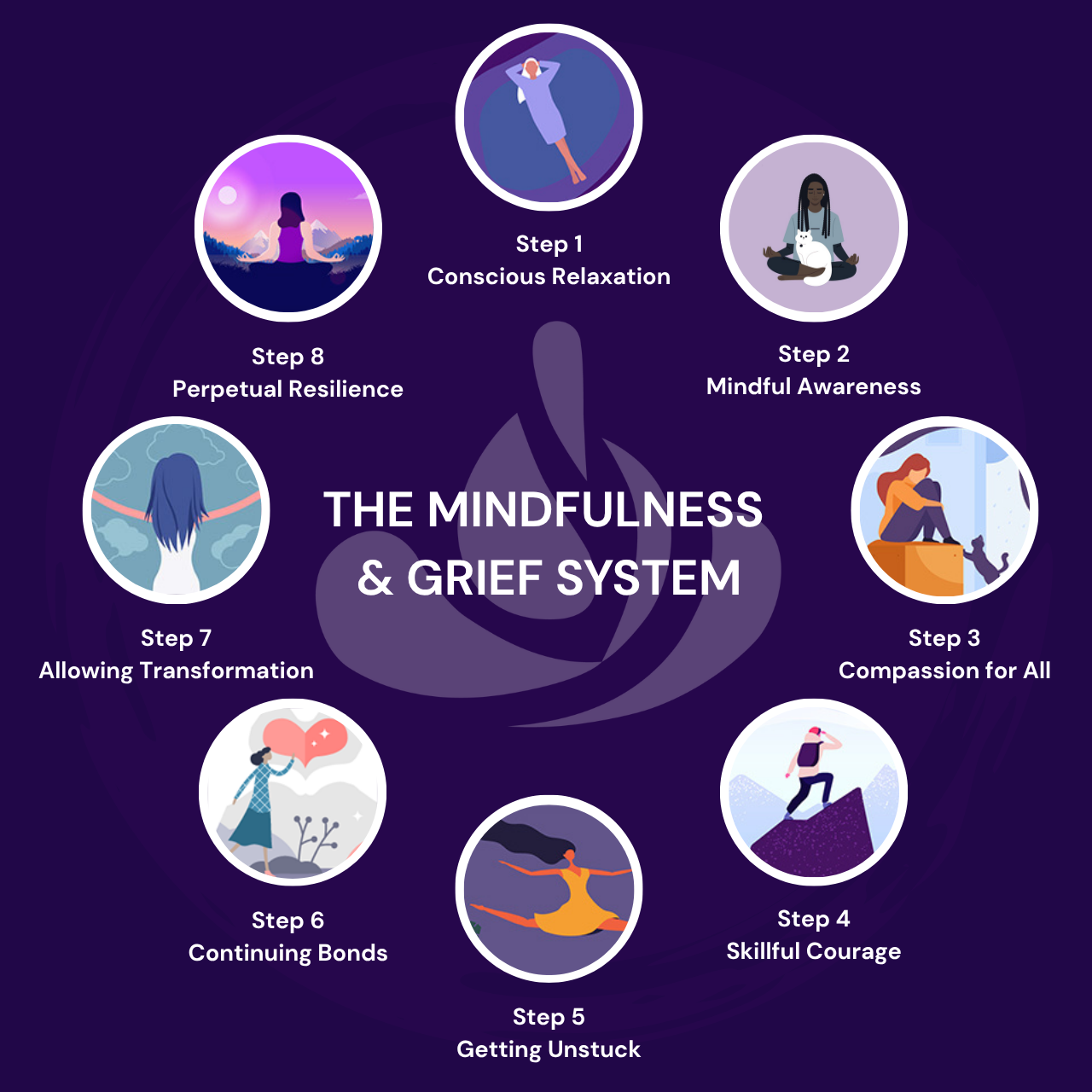
Below you will find eight guided practices, one connected to each step of the Mindfulness & Grief System. You do not need to do them in order. Start with the practice that best fits what you need today.

Heather Stang teaching meditation for grief

PART OF A LARGER FRAMEWORK

These Practices Sit Inside the 8-Step Mindfulness & Grief System

The meditations on this page connect most closely with the foundational steps of Heather Stang’s Mindfulness & Grief System, especially Conscious Relaxation, Mindful Awareness, Compassion for All, Skillful Courage, and reflective practices used in Getting Unstuck.

The larger system integrates contemplative practice with thanatology, contemporary grief theory, journaling, embodied awareness, and trauma-sensitive principles.

Read the history and foundations of the Mindfulness & Grief System
The 8-Step Mindfulness and Grief System

WHAT IS MEDITATION?

A Practice of Choosing Where Your Attention Goes

Meditation is less about emptying the mind and more about learning how to relate to your experience with greater awareness and intention.

There are many ways to meditate. Some practices give the mind one place to rest, such as the breath or a mantra. Others invite you to notice thoughts, sensations, emotions, or a meaningful question.

Heather often describes meditation as a form of compassionate attention training. You practice noticing when the mind wanders and gently choosing where to place attention again.

That matters in grief because thoughts can move quickly toward regret, worry, replay, fear, or painful stories. Meditation gives you another way to be with those experiences without demanding that they disappear.

“There are no ‘bad’ meditators. There are only people who meditate, and people who do not.”

Heather Stang Living With Grief

WHY MEDITATE DURING GRIEF?

Grief Affects More Than Emotion

Loss can affect attention, sleep, the body, the nervous system, relationships, identity, and a person’s sense of safety or steadiness. Different meditation practices can support different needs.

Settle attention Give a busy or restless mind one place to return.
Support rest Use calming practices when grief is making it difficult to settle.
Ease physical tension Notice and soften unnecessary holding in the body.
Meet difficult emotions Approach sadness, anger, fear, or despair without feeding the story loop.
Practice self-compassion Respond to guilt, judgment, and pain with greater kindness.
Reflect on meaning Create room for questions about identity, values, connection, and life after loss.
You do not have to force yourself to meditate. If closing your eyes, focusing inward, or sitting still feels too activating, keep your eyes open, shorten the practice, orient to the room, move your body, or choose a different form of support.

8 GUIDED MEDITATIONS FOR GRIEF

Choose the Practice That Fits What You Need Right Now

Each meditation below connects to one step of the Mindfulness & Grief System. The steps are not stages, and the meditations are not a sequence you have to complete. Use them as different places to begin, depending on what is happening in your body, mind, heart, relationships, and life.

Conscious Relaxation icon

STEP 1

Conscious Relaxation

When grief feels physically tense, restless, or hard to settle.

Grief can leave the body anxious, tight, exhausted, or unable to sleep. Conscious Relaxation uses focused attention and simple regulation practices to help the nervous system settle and restore a sense of agency.

Counting Your Breath A simple focusing practice for steadiness and regulation.
Mindful Awareness icon

STEP 2

Mindful Awareness

When your mind keeps traveling into regret, fear, or mental replay.

Mindful Awareness widens attention to present-moment experience. Instead of analyzing everything that arises, you practice noticing through the senses, the body, thoughts, and emotions with curiosity and steadiness.

Awareness Break A brief practice for returning to the present moment.
Compassion for All icon

STEP 3

Compassion for All

When grief is being intensified by guilt, shame, loneliness, or harsh self-talk.

Compassion for All helps soften self-criticism and creates a kinder inner relationship with suffering. It includes mindfulness, common humanity, and self-kindness, while making room for compassion toward others without abandoning yourself.

Self-Compassion Mantra A guided practice for meeting pain with care rather than criticism.
Skillful Courage icon

STEP 4

Skillful Courage

When you want to turn toward a difficult emotion without forcing yourself through it.

Skillful Courage is not the demand to “be strong.” It is the ability to meet difficult emotions with steadiness, vulnerability, awareness, and choice. Sometimes the skillful move is to lean in. Sometimes it is to step back and regulate.

R.A.I.N. Meditation Recognize, allow, investigate, and nurture what is present with compassion.
Getting Unstuck icon

STEP 5

Getting Unstuck

When rumination, avoidance, or a single painful story is narrowing your perspective.

Getting Unstuck helps you notice common grief and mindfulness obstacles and create a little more room around them. Structured reflection, journaling, and attention practices can help loosen repetition without pretending the loss is different.

Gratitude Meditation A practice for noticing what remains supportive without forcing positivity.
Continuing Bonds icon

STEP 6

Continuing Bonds

When you are exploring how love, memory, and connection continue after loss.

Continuing Bonds recognizes that a relationship does not simply disappear after death. Connection may continue through memory, ritual, values, legacy, internal dialogue, and the ways a person still shapes who you are.

For complicated relationships and non-death loss, the work may look different. The goal is not to force connection, but to let the relationship evolve in a way that fits the reality of the loss.

Journey to Your Heart Center A reflective meditation for connection, memory, and the inner experience of love.
Allowing Transformation icon

STEP 7

Allowing Transformation

When grief has changed your identity, priorities, relationships, or sense of what comes next.

Grief reshapes us whether we want it to or not. Allowing Transformation makes room to notice who you are becoming without turning hardship into a silver lining or suggesting the loss had to happen for growth to occur.

Who Am I Now? A contemplative practice for identity, change, and the person you are becoming.
Perpetual Mindfulness icon

STEP 8

Perpetual Mindfulness

When you want a practice you can keep returning to as grief and life continue to change.

Grief does not end on a schedule. Perpetual Mindfulness is about sustainable practice, self-care, community, and the ability to return to awareness over time. It helps you notice what is here now and choose what supports this version of your life.

Choiceless Awareness An open-awareness practice for noticing experience as it changes from moment to moment.

TAKE THE PRACTICE FURTHER

Are You Here for Your Own Grief, or to Support Someone Else?

These meditations can be useful on their own. If you want more structure, there are two different ways to go deeper.

FOR HELPING PROFESSIONALS

Want to Learn How to Teach Meditation for Grief?

The Mindfulness & Grief Coach Certification teaches you how to use meditation, journaling, embodied practice, and the full 8-Step System thoughtfully with grieving people.

  • Learn how grief can change attention, regulation, and the meditation experience.
  • Practice adapting mindfulness for different people, losses, and nervous-system needs.
  • Learn when a meditation may help, when to modify it, and when not to use it.
  • Build confidence facilitating grief support without turning the framework into a formula.
Explore the Certification

FOR YOUR OWN GRIEF

Want to Learn How to Grieve More Mindfully?

Awaken is Heather’s ongoing online grief support program for people who want structure, guided practice, and compassionate community as they learn to live with loss.

  • Work through the full 8-Step Mindfulness & Grief course at your own pace.
  • Join weekly live grief support and mindfulness sessions led by Heather.
  • Use the private library of meditations, journaling prompts, and supportive practices anytime.
  • Practice with support instead of trying to figure out grief alone.
Explore Awaken Grief Support

IF MEDITATION FEELS HARD RIGHT NOW

Make the Practice Smaller

Grief can change concentration, memory, patience, energy, and the ability to sit still. Difficulty meditating does not mean you are doing it wrong.

Try one minute instead of twenty. Keep your eyes open. Listen while walking slowly. Put a hand on a steady surface. Notice three sounds in the room. Use a guided practice instead of sitting in silence.

The practice should meet you where you are. You do not have to meet an idea of what meditation is supposed to look like.

Heather Stang, thanatologist, author, and creator of the Mindfulness and Grief System

ABOUT HEATHER STANG

Grief Education Grounded in Thanatology and Contemplative Practice

Heather Stang, MA, C-IAYT, is a thanatologist, author, grief educator, speaker, and creator of the 8-Step Mindfulness & Grief System.

Her work brings together contemporary grief theory, mindfulness, trauma-sensitive practice, self-compassion, journaling, yoga therapy, and embodied approaches to grief support.

Her Mindfulness & Grief approach is featured in The Handbook of Grief Therapies, and she received the 2025 Association for Death Education and Counseling Clinical Practice Award.

RETURN WHEN YOU NEED TO

You Do Not Have to Meditate Your Way Out of Grief

Use these practices as places to return to for steadiness, awareness, compassion, and reflection. Grief does not need to be solved before you are allowed to rest.

Choose a Guided Practice